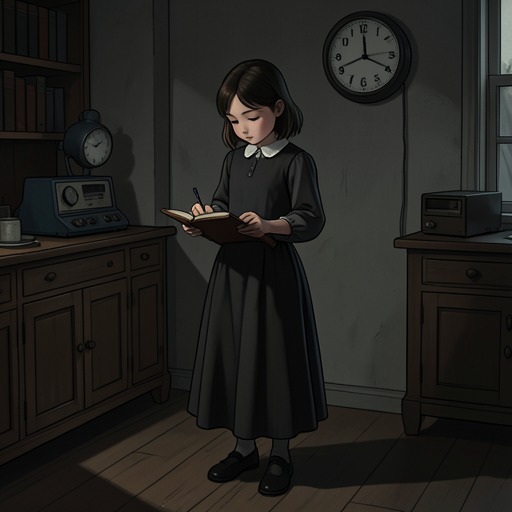
Paula
A Woman of SubstancePaula, Daisy’s daughter and Emma Harte’s favorite granddaughter, is both a promising businesswoman and the person closest to Emma. Raised into the orbit of Harte Enterprises, she earns a significant role through unusual commercial ability and demanding work. Her relationship with Jim Fairley then tests whether Emma’s old family grievance will govern another generation, and Paula’s happiness becomes the occasion for Emma to set that grievance aside.
Identity and Early Attachment
Emma’s affection for Paula is evident in the way she watches over her: she notices her granddaughter’s thinness, feels a flicker of guilt at driving her too hard, and takes pride in the resemblance between Paula’s resolute chin and her own. Paula is tall and slender, with glossy black hair, a pale, expressive face, and striking blue eyes. Emma sees her not simply as a beloved child but as someone in whom many of her own hopes might take root.
That closeness began early. As a little girl, Paula gravitated to her grandmother and was fascinated by the family business. She enjoyed going with Emma to the office and sitting beside her while she worked. The bond combined affection with an unusual shared interest: Paula did not merely inherit a place in the family but developed a sustained curiosity about how its enterprises operated.
Business Apprenticeship and Authority
Paula’s aptitude became apparent while she was still in her teens. She showed an understanding of complex business dealings that astonished Emma, who had not seen comparable ability in her own children. At sixteen, Paula rejected the prospect of finishing school in Switzerland and went straight to work for her grandmother. Emma then trained her relentlessly in the different sides of Harte Enterprises, holding her to a harsher standard than other employees.
By twenty-three, Paula had become capable and mature enough for a position of real significance. Emma made her personal assistant and right hand, giving her access to much of the company’s business as well as private affairs. At Emma’s discretion, Paula also became a confidante on family matters. This elevation provoked Kit, Emma’s eldest son and an employee of the organization: he found Paula’s access and influence intolerable. The appointment thus established both Emma’s confidence in Paula and the tension her growing authority created within the family business.
Paula’s work is not only a preparation for future responsibility; it is also where she directs herself when distressed. During the period when she believed a future with Jim was impossible, she pushed aside her feelings and poured her energy into work, even as she suffered. Her business training offers purpose and discipline, but it cannot erase the personal cost of the separation.
The Sitex Test
Paula’s education extends beyond figures and corporate procedure. After Emma’s hard-fought contest at Sitex, Paula is shaken by the ferocity of the struggle and wonders whether she could show the same icy tenacity in dealing with powerful men. She is not simply awed by Emma’s victory: she has to reckon with her own nervousness and with the possibility of failing the person whose judgment matters most to her.
Her confidence returns as she recognizes the distinction Emma has drawn between money and power. Paula understands that the Sitex board responds to power more than wealth, and admits that her deeper fear was failing Emma, not facing the board itself. Emma encourages her not to let fear of failure prevent achievement and argues that power can be ennobling as well as dangerous. Paula answers with renewed assurance. The exchange marks a shift from observing Emma’s strength to articulating a principle of power for herself.
Jim Fairley and Emma’s Reversal
Paula’s love for Jim brings her into painful contact with the family history that Emma has long treated as a warning. Emma tells Paula that the Fairleys have brought her pain since she was fourteen, and that she had tried to keep her children—and, without fully realizing it, her grandchildren—outside their orbit. Paula’s relationship with Jim therefore carries more than private romantic stakes: it crosses a boundary Emma had maintained for decades.
When Emma finally withdraws her objection, Paula can scarcely believe the change. Emma explains that pride and bitterness about events sixty years earlier should not stand in the way of the person she loves most. She has spoken with Jim, learned that his intentions are serious, and given him permission and her blessing to marry Paula. Paula tells her grandmother that she loves Jim and that the decision has changed her life. Emma, in turn, says Paula’s happiness matters more than anything else to her.
Emma had also hired Jim for the newspaper company after judging him the strongest candidate, despite her prejudice against his family. His ability, rather than the Fairley name, made him the right choice; Emma admits, too, that employing a Fairley gave her some satisfaction. She had not expected him and Paula to meet, since Paula had no role in the publishing side of Harte Enterprises. Her question about how they came together underscores how their relationship has emerged across boundaries she had not anticipated.
Narrative Significance
Paula joins two forms of inheritance that Emma has tried to manage separately: the business she has built and the family history that has shaped her judgments. Her advancement demonstrates that Emma’s trust is grounded in Paula’s demonstrated skill, while the tension with Kit shows that this trust redistributes influence among the generations. Paula’s response at Sitex suggests that she is learning to meet power on its own terms rather than merely benefiting from proximity to it.
Her relationship with Jim offers a different measure of inheritance. Emma’s old bitterness has protected her family from a painful history, but it also threatens Paula’s future. By blessing the match, Emma chooses Paula’s happiness over the pride that once governed her decisions. The prospective marriage does not erase the past; it changes what the past is allowed to decide.